
From stakeholders to capabilities: deriving a capability map from use cases and operational scenarios
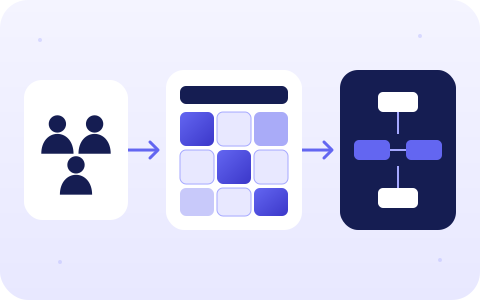
A capability map is only useful if each capability can say who it serves and why. Starting from stakeholders keeps it honest.
Many capability maps are drawn from an organisation chart or a list of applications. They look complete, but nobody can say which need a given box serves. The result is hard to defend and hard to prioritise.
Start instead with the stakeholders: customers, users, partners, regulators, internal teams. For each one, write down what they expect, in their own words. These expectations are the needs the architecture must answer.
Then turn each need into a use case, and each use case into an operational scenario: a short sequence of steps describing how the need is actually met, who acts, and what information moves. The steps of these scenarios are the functions the organisation must be able to perform.
Group those functions by what they achieve, not by who performs them today. Each group becomes a capability. Order the capabilities along the value chain, from the first contact to the delivered result, and keep the top level small enough to read at a glance.
Finally, keep the links. Each capability should state which need it serves, through which use case and scenario. When a need has no capability, or a capability serves no need, the map shows it immediately, and the discussion moves from opinions to facts.
Rules first, language models where judgment is needed

Not every function needs the same kind of tool. Choosing well starts with asking what the function really requires.
When a new process is designed, it is tempting to apply the most recent technology everywhere. In practice, most functions are better served by something simpler, more predictable and easier to audit.
Start with rules. If the expected result can be written down, checked and repeated, automated rules are the right answer: validations, calculations, thresholds, routing. They are fast, cheap, and their behaviour can be explained line by line.
Use a language model where the input is text of varying form and some interpretation is needed: reading a letter, summarising a file, drafting a reply. Keep it supervised: rules check what it produces, its sources are visible, and a person reviews the output before it has any effect.
Keep the decision with a person when the stakes carry accountability, affect people directly, or require a trade-off between objectives. The tools prepare the decision; they do not take it.
Making this choice function by function, and writing down why, gives a design that is easier to defend, cheaper to run and simpler to change when needs evolve.
From options to OKRs: testing an idea’s systemic coherence before committing
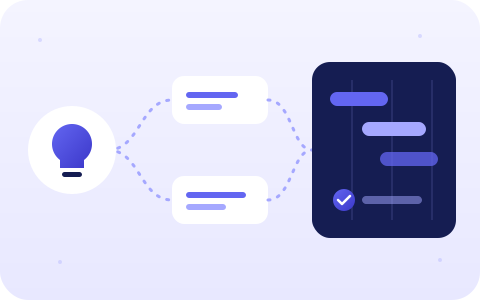
An idea can look excellent on its own and still disrupt the rest of the system. Test it on the whole model before committing budget and teams.
A transformation idea usually arrives as a single proposal: a new platform, a merged process, an outsourced activity. Judged alone, it often looks convincing. Its cost appears elsewhere: in a capability that loses support, a flow that breaks, a team that gains work.
Begin by stating the options explicitly, including doing nothing. For each one, list what it changes: which capabilities, applications, flows and requirements are affected. Unknowns are written down as unknowns, not hidden.
Compare the options on the same criteria: value delivered, cost, risk, time, and effect on the needs the architecture serves. Read upside and risk together; an unknown counts as a risk until it is confirmed.
Once an option is chosen, record the decision and its reasons, then translate it into objectives and key results tied to the value chain. Each key result should be measurable and linked to the capability it improves.
The action plan follows from these results. If later results drift, the record shows which assumption to revisit, and the model shows what else would be affected by a change of course.